REVIEW [Hong Kong]: ARTCO: "Jack Tworkov: From Gesture to Measure: Poetics Within the Calm Grid" (May 1, 2026)
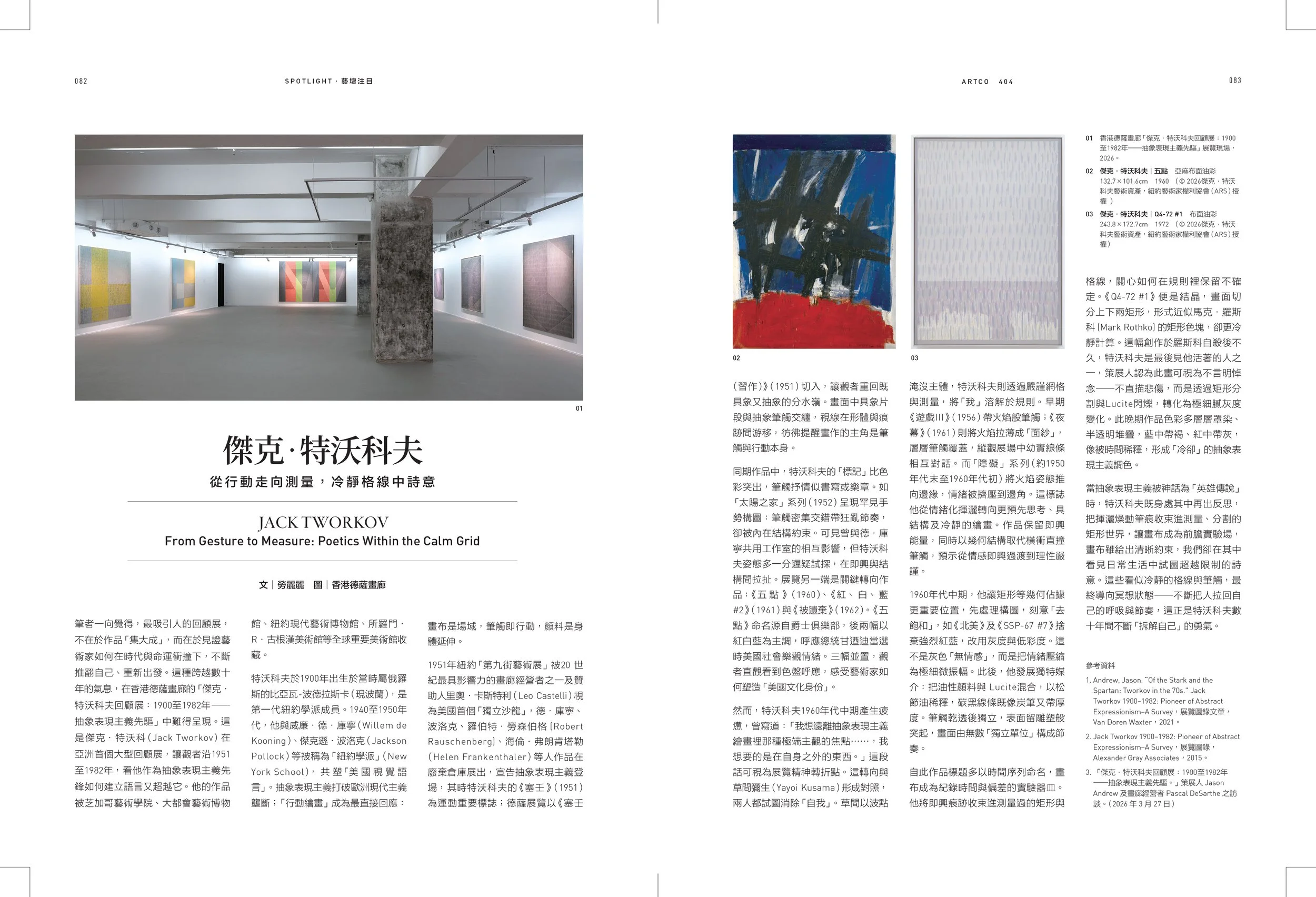
[Translation prepared by de Sarthe]
by Lo Lai Lai Natalie
HONG KONG– The author has always believed that the most compelling retrospective exhibitions are not about presenting a "comprehensive collection" of works, but about witnessing how an artist, under the collision of era and fate, continuously overturns themselves and starts anew. This breath spanning decades is rarely captured, yet it is remarkably presented in "Jack Tworkov Retrospective: 1900–1982 – Pioneer of Abstract Expressionism" at de Sarthe Gallery in Hong Kong. This is Jack Tworkov's first major retrospective in Asia, allowing viewers to trace his journey from 1951 to 1982, observing how he, as a pioneer of Abstract Expressionism, established a visual language and then transcended it. His works are held in the collections of major global institutions such as the Art Institute of Chicago, the Metropolitan Museum of Art, the Museum of Modern Art in New York, and the Solomon R. Guggenheim Museum.
Tworkov was born in 1900 in Biała Podlaska, then part of Russia (now Poland), and was a member of the first-generation New York School. During the 1940s and 1950s, he, along with Willem de Kooning, Jackson Pollock, and others, formed the "New York School," collectively shaping an "American visual language." Abstract Expressionism broke the monopoly of European modernism; "Action Painting" became its most direct response: the canvas was an arena, the brushstroke an action, and paint an extension of the body.
The 1951 "Ninth Street Art Exhibition" in New York, regarded by Leo Castelli—one of the 20th century's most influential gallery owners and patrons—as America's first "independent salon," featured works by de Kooning, Pollock, Robert Rauschenberg, Helen Frankenthaler, and others in a vacant warehouse, announcing the arrival of Abstract Expressionism. Tworkov's Siren (1951) was a key emblem of the movement. The de Sarthe exhibition begins with Siren (Study) (1951), returning viewers to that pivotal moment where figuration and abstraction intersect. On the canvas, figurative fragments intertwine with abstract brushstrokes, the gaze wandering between form and trace, as if reminding us that the true protagonists of the painting are the brushstrokes and actions themselves.
In works from this period, Tworkov's "marks" are more prominent than color, with lyrical brushstrokes resembling writing or musical phrases. For instance, the "House of the Sun" series (1952) reveals a rare gestural composition: densely interwoven brushstrokes carry a frenetic rhythm, yet are restrained by an internal structure. The mutual influence from sharing a studio with de Kooning is evident, but Tworkov's gestures carry a hint more hesitation and probing, caught between improvisation and structure. At the other end of the exhibition are key transitional works: Five Points (1960), Red, White, Blue #2 (1961), and Abandoned (1962). Five Points is named after a jazz club, while the latter two, dominated by red, white, and blue, echo the optimistic mood of American society following President Kennedy's election. Viewed together, these three paintings allow viewers to intuitively see the color palette's resonance and feel how the artist helped shape an "American cultural identity."
However, by the mid-1960s, Tworkov experienced a sense of weariness, writing: "I want to get away from the extremely subjective focus in Abstract Expressionist painting... I want something outside myself." This statement can be seen as the spiritual turning point of the exhibition. This shift forms an interesting contrast with Yayoi Kusama; both artists attempted to dissolve the "self." Kusama submerged the subject with polka dots, while Tworkov dissolved the "I" into rules through rigorous grids and measurements. The early Game III (1956) features flame-like brushstrokes; Nightfall (1961) stretches these flames thin into a "veil," with layered brushstrokes covering the surface. Throughout the exhibition, fine, solid lines engage in dialogue. The "Barrier" series (late 1950s–early 1960s) pushes the fiery gestures to the edges, compressing emotion into the corners. This marks his transition from emotional exuberance to a more premeditated, structured, and cool-headed painting. The works retain improvisational energy while replacing unrestrained brushstrokes with geometric structures, foreshadowing a move from emotional spontaneity to rational rigor.
By the mid-1960s, he gave geometric forms like rectangles a more prominent role, prioritizing composition and deliberately "desaturating" the palette. Works like North America and SSP-67 #7 abandon strong reds and blues in favor of grayscale and low chroma. This is not an "emotionless" gray but rather emotion compressed into extremely subtle amplitudes. Subsequently, he developed a unique medium: mixing oil paint with Lucite and thinning it with turpentine, resulting in carbon-black lines that resemble charcoal yet possess thickness. Once dry, the brushstrokes stand independently, leaving sculptural ridges on the surface; the picture plane becomes a rhythm composed of countless "independent units."
From this point, his works are often titled with chronological sequences, the canvas becoming an experimental vessel recording time and deviation. He channeled improvisational traces into measured rectangles and grids, concerned with preserving uncertainty within rules. Q4-72 #1 is a crystallization of this approach. The canvas is divided into two rectangles, formally reminiscent of Mark Rothko's color fields, yet more coolly calculated. Created shortly after Rothko's suicide (Tworkov was among the last to see him alive), the curator suggests this painting can be seen as an unspoken elegy—not directly depicting grief, but transforming it, through rectangular division and the shimmer of Lucite, into extremely nuanced gradations of gray. These late works often feature layered glazes and translucent accumulations of color—browns within blues, grays within reds—as if diluted by time, forming a "cooled" Abstract Expressionist palette.
While Abstract Expressionism was often mythologized as a "heroic legend," Tworkov, from within it, offered reflection. He reined in the restless, sweeping brushmarks into a world of measured, segmented rectangles, turning the canvas into a forward-looking laboratory. Although the canvas imposes clear constraints, within them we see the poetry of attempting to transcend limitations in everyday life. These seemingly calm grids and brushstrokes ultimately lead to a meditative state—continuously pulling one back to one's own breath and rhythm. This is precisely the courage Tworkov demonstrated over decades of constantly "deconstructing himself."
_______
References:
1. Andrew, Jason. "Of the Stark and the Spartan: Tworkov in the 70s." Exhibition catalogue essay, Van Doren Waxter, 2021.
2. Exhibition catalogue, Alexander Gray Associates, 2015.
3. "Jack Tworkov Retrospective: 1900–1982 – Pioneer of Abstract Expressionism." Interview with curator Jason Andrew and gallery owner Pascal de Sarthe. (March 27, 2026)